What We're Meant to Misplace
A review of Forgetting: The Benefits of Not Remembering by Scott Small


I’m in my forties. The occasional slippage of mental acuity is now part of my life, and maybe not as occasional as I’d like. If it weren’t for tools like Apple AirTags, which I keep strapped to my keys and wallet, I’d be late for many, many appointments.
(Admission: I had to look up the name “AirTag” while writing this!)
If I’m honest, I experienced this kind of forgetting well before I reached my fifth decade. It’s demonstrably normal, as both my doctor and author Scott Small have assured me. And now, having read Small’s book Forgetting, I can appreciate that it’s not just normal. It's healthy.
Thanks to Small, I feel genuine gratitude for my brain’s capacity to forget.
But my enthusiasm was hard won.
Small, a memory researcher and the director of Columbia University’s Alzheimer’s Disease Research Center, opens with a quick tour of brain anatomy, complete with diagrams. He punctuates it with an anecdote about a patient, an accomplished lawyer known for his memory, who suddenly can’t recall a client’s name. Small weaves the anatomy into the story to explain what, mechanically, might be happening in the lawyer’s brain.
I found that first chapter dull. It follows a familiar science-writing script, and it does so without much flair. I don’t mind an anatomy lesson, but I couldn’t connect to the character in the anecdote. Here was a wealthy professional, worried enough about a moment of forgetfulness to seek out a world-class specialist right away.
Still, the chapter does its job. It establishes a key point: memory is physical. The formation of new memories and the fading of old ones correspond to real changes in the brain’s wiring and structure.
At that point, I put the book down for a few weeks. It wasn’t until a bout of boredom while waiting for my daughter's gymnastics lesson to end that I picked it back up.
I’m glad I did.
From chapters two onwards, the book opens up. Small shares not just more science, but more of himself. The writing feels less restrained. The explanations get clearer, the anecdotes more inviting, and the ideas more illuminating.
In the book’s prologue, Small sets an ambitious goal: to convince the reader that no one should want a mind that never forgets. And despite the bland opening chapter, he makes his case.
He shows what it can mean to remember too well. He argues that conditions as different as autism, PTSD, and pathological fear involve a failure of forgetting, where certain memories refuse to loosen their grip.
Chapter Four, “Fearless Minds,” hit me hardest. Small describes the amygdala’s role in tagging memories with emotion. Fear and anger, he explains, tend to make memories stickier. They latch on. They recur.
The amygdala has an obvious purpose. It helps regulate stress hormones like adrenaline and cortisol. It’s a key part of fight-or-flight, an evolutionary tool that helped humans survive. But when it’s chronically overworked, it can start to do damage.
Small points to imaging research suggesting that repeated exposure to violence and fear is associated with structural changes in the amygdala, as if the brain records stress the way skin records scars. That framing made an old cliché feel newly literal. The schoolyard bully, lashing out to hide fear, isn’t just a psychological story. It has a chemical and physical dimension too.
With help, people can learn to calm their threat response. Over time, the brain can change. Some memories lose their charge. Some reactions soften. Forgetting, in Small’s telling, isn’t a failure. It’s a kind of repair.
I couldn’t help thinking about how this maps onto today’s social and political climate, where cruelty seems to abound. Cruelty often comes from a mind that is stuck, replaying a threat, nursing a grievance, unable to let a painful memory fade into proportion. And the tragedy is that cruelty spreads. Victims collect their own fear-laden memories. Their nervous systems harden. The cycle continues.
To break the cycle, what both victim and perpetrator need is the right kind of forgetting. Not erasure, denial, or amnesia, but a loosening of the memory’s grip, so the past stops hijacking the present.
Nietzsche, in On the Use and Abuse of History, wrote:
In the smallest and greatest happiness there is always one thing that makes it happiness: the power of forgetting.
Thanks to Scott Small’s Forgetting: The Benefits of Not Remembering, I now understand that “power of forgetting” as more than philosophical, and more than psychological. It’s physical. It reshapes the brain. And it deserves real credit for keeping us healthy, happy, and sane.
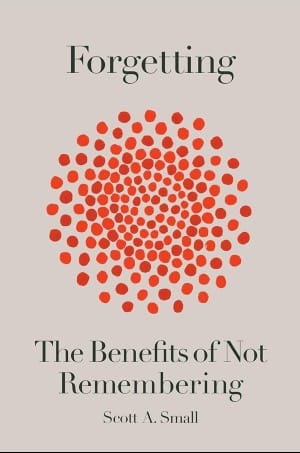
Want to read Forgetting: The Benefits of Not Remembering? Use the link below to purchase the book and a small portion of your purchase will go to supporting me and this site. Thanks!